Loading...
Loading...

Society for Neuroscience ’25 Meeting Report for Chen Institute

Meeting Reports

|
By Arantzazu San Agustín, PhD


Each year, scientists from around the world gather at the Society for Neuroscience (SfN) Annual Meeting, one of the largest and most anticipated international conferences in neuroscience. SfN provides a unique forum for presenting and discussing advances across a wide range of subfields, from cellular and molecular neuroscience to systems, cognitive, and behavioral approaches. Beyond facilitating interactions with researchers working on closely related topics, the meeting promotes exposure to work conducted at different levels of analysis, fostering conceptual integration and the generation of new ideas.

This breadth reflects the inherently holistic nature of neuroscience. Although the nervous system can be studied across multiple scales, it operates as a dynamic and highly interconnected system in which phenomena at higher levels of organization, such as behavioral, emotional, or perceptual processes, impact molecular and microscopic mechanisms, including neurochemical signaling, synaptic plasticity, or genetic changes, and vice versa. In this sense, SfN promotes not only the dissemination of domain-specific advances, but also the integration of perspectives across levels of investigation.

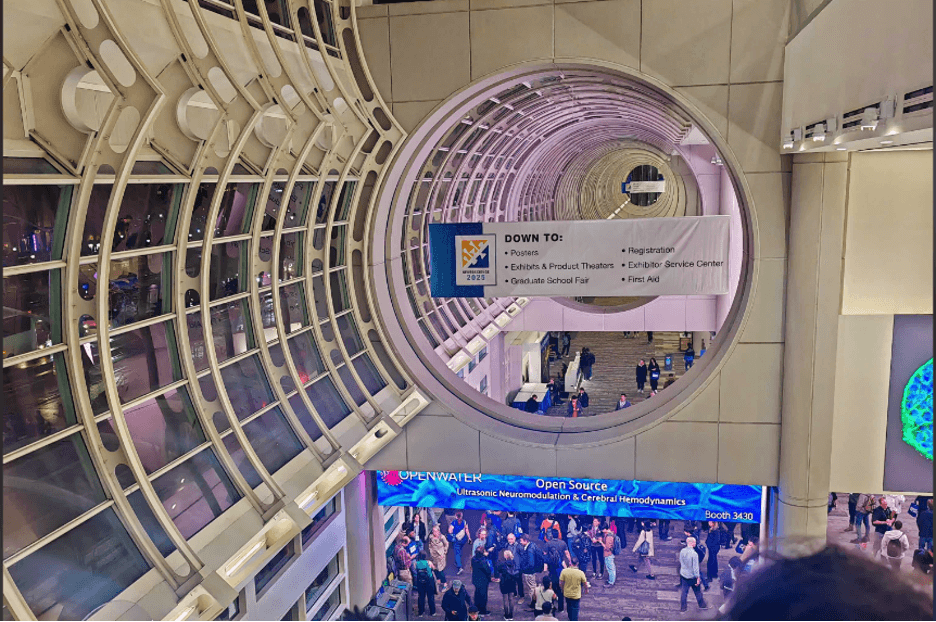
This integrative spirit characterized my participation in the most recent SfN meeting, held on November 15–19 in San Diego. I attended as a Trainee Professional Development Award (TPDA) recipient, with additional support from the Tianqiao & Chrissy Chen Institute through the Chen Science Writer Fellowship. The Chen Institute plays a key role in promoting scientific communication and professional development among early-career researchers, while fostering the dissemination of neuroscience research to both specialized and broader audiences.
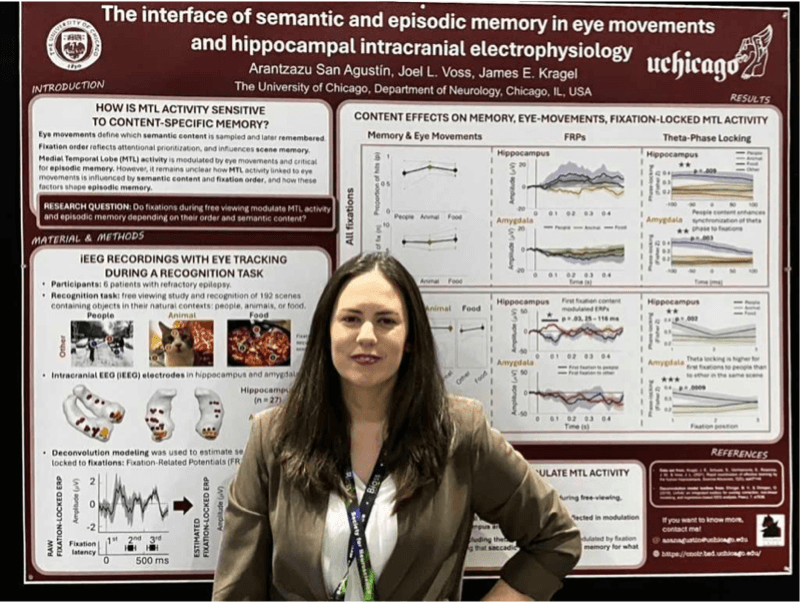
My poster presentation during the TPDA special session in SfN25

My poster presentation during the TPDA special session in SfN25

Through this support, I was able to increase the visibility of my research on human memory using intracranial electroencephalography (EEG) recordings. My work focuses on how the hippocampus encodes semantic information on a fixation-by-fixation basis during visual exploration. Our findings show that fixation-locked hippocampal activity is selective to both the semantic content and the temporal order of visual sampling, with a particular emphasis on early fixations and the processing of people-related stimuli. In parallel, I am pursuing research involving transcranial magnetic stimulation (TMS) in humans with intracranial implants, aimed at investigating how hippocampal electrophysiological correlates of memory can be neuromodulated. For these reasons, my focus during SfN 2025 was on recent advances in memory research across multiple levels of analysis.

Neural mechanisms supporting memory formation, consolidation, and retrieval was a central theme of SfN 2025, with a particular emphasis on hippocampal dynamics. Several presentations addressed sharp-wave ripples (SWRs) as a mechanism supporting experience-dependent reactivation in the hippocampus. Work presented by Liset de la Prida and colleagues emphasized that SWRs are highly variable events and that this variability carries meaningful information about underlying synaptic inputs. By applying dimensionality-reduction approaches to ripple waveforms recorded in hippocampal CA1, these studies proposed a framework in which SWRs can be organized along a multi-dimensional organization rather than treated as uniform events.

Read more in the meeting report.

By Arantzazu San Agustín, PhD


Each year, scientists from around the world gather at the Society for Neuroscience (SfN) Annual Meeting, one of the largest and most anticipated international conferences in neuroscience. SfN provides a unique forum for presenting and discussing advances across a wide range of subfields, from cellular and molecular neuroscience to systems, cognitive, and behavioral approaches. Beyond facilitating interactions with researchers working on closely related topics, the meeting promotes exposure to work conducted at different levels of analysis, fostering conceptual integration and the generation of new ideas.

This breadth reflects the inherently holistic nature of neuroscience. Although the nervous system can be studied across multiple scales, it operates as a dynamic and highly interconnected system in which phenomena at higher levels of organization, such as behavioral, emotional, or perceptual processes, impact molecular and microscopic mechanisms, including neurochemical signaling, synaptic plasticity, or genetic changes, and vice versa. In this sense, SfN promotes not only the dissemination of domain-specific advances, but also the integration of perspectives across levels of investigation.

This integrative spirit characterized my participation in the most recent SfN meeting, held on November 15–19 in San Diego. I attended as a Trainee Professional Development Award (TPDA) recipient, with additional support from the Tianqiao & Chrissy Chen Institute through the Chen Science Writer Fellowship. The Chen Institute plays a key role in promoting scientific communication and professional development among early-career researchers, while fostering the dissemination of neuroscience research to both specialized and broader audiences.

My poster presentation during the TPDA special session in SfN25

My poster presentation during the TPDA special session in SfN25

Through this support, I was able to increase the visibility of my research on human memory using intracranial electroencephalography (EEG) recordings. My work focuses on how the hippocampus encodes semantic information on a fixation-by-fixation basis during visual exploration. Our findings show that fixation-locked hippocampal activity is selective to both the semantic content and the temporal order of visual sampling, with a particular emphasis on early fixations and the processing of people-related stimuli. In parallel, I am pursuing research involving transcranial magnetic stimulation (TMS) in humans with intracranial implants, aimed at investigating how hippocampal electrophysiological correlates of memory can be neuromodulated. For these reasons, my focus during SfN 2025 was on recent advances in memory research across multiple levels of analysis.

Neural mechanisms supporting memory formation, consolidation, and retrieval was a central theme of SfN 2025, with a particular emphasis on hippocampal dynamics. Several presentations addressed sharp-wave ripples (SWRs) as a mechanism supporting experience-dependent reactivation in the hippocampus. Work presented by Liset de la Prida and colleagues emphasized that SWRs are highly variable events and that this variability carries meaningful information about underlying synaptic inputs. By applying dimensionality-reduction approaches to ripple waveforms recorded in hippocampal CA1, these studies proposed a framework in which SWRs can be organized along a multi-dimensional organization rather than treated as uniform events.

Read more in the meeting report.
Loading...

Cornerstone Partnerships

Frontier Labs

Documentary

Loading...

AI Prize

Chen Scholars Program

Training Programs

Stanford IPL

Loading...

AIAS 2025

Conference Program

Conference Partners

Conference Reports

About

Founders’ letter

Our Philanthropy

Vision

Team

Join Us

Newsroom

Chen Institute blog

Newsletter

Annual Report

© 2026 Tianqiao and Chrissy Chen Institute

Terms of Use

Privacy Policy

Contact us

Newsletter

Subscribe

We're Hiring!

Loading...

Cornerstone Partnerships

Frontier Labs

Documentary

Loading...

AI Prize

Chen Scholars Program

Training Programs

Stanford IPL

Loading...

AIAS 2025

Conference Program

Conference Partners

Conference Reports

About

Founders’ letter

Our Philanthropy

Vision

Team

Join Us

Newsroom

Chen Institute blog

Newsletter

Annual Report

© 2026 Tianqiao and Chrissy Chen Institute

Terms of Use

Privacy Policy

Contact us

Newsletter

Subscribe

We're Hiring!

Loading...

Cornerstone Partnerships

Frontier Labs

Documentary

Loading...

AI Prize

Chen Scholars Program

Training Programs

Stanford IPL

Loading...

AIAS 2025

Conference Program

Conference Partners

Conference Reports

About

Founders’ letter

Our Philanthropy

Vision

Team

Join Us

Newsroom

Chen Institute blog

Newsletter

Annual Report

© 2026 Tianqiao and Chrissy Chen Institute

Terms of Use

Privacy Policy

Contact us

Newsletter

Subscribe

We're Hiring!