Loading...
Loading...
Loading...

eWEAR: Improving performance of polymer semiconductors with metal-ligand based mechanophores

Meeting Reports

|
Jun 18, 2022

With the rise of wearable electronics, it becomes increasingly crucial to develop electronic materials that can resist mechanical strain caused by deformations without compromising electrical properties. One of the most important electrical components in wearable electronics is the polymerbased field-effect transistor (FET), a type of polymer semiconductor (PSC) device that uses electric field to control the flow of current in a semiconductor.

However, PSCs are usually brittle due to rigid conjugated chemical backbones and ordered molecular packing, which are necessary for charge carrier transport and high stretchability. While methods like strain engineering can improve mechanical properties, they require additional and cumbersome processing steps.

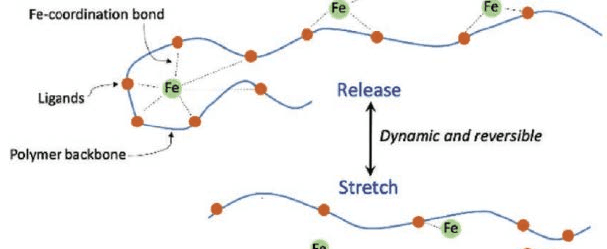
In a recent paper published in Advanced Functional Materials, a team of researchers led by Professor Zhenan Bao and Dr. Hung-Chin Wu in the Department of Chemical Engineering at Stanford University made use of metal-ligand based mechanophores to improve the mechanical and electrical performance of their PSCs commonly found in wearable electronics.

“We wanted to develop a polymer semiconductor, without blending secondary elastomers or incorporating additives, that possesses both high mechanical robustness and electronic performance under strain. We discovered that the molecular ordering of semiconducting polymers can be effectively manipulated by the dynamic of metal-ligand coordination bonds, leading polymer semiconductors to be highly stretchable without sacrificing charge transporting,” says Wu.


Read the full article

With the rise of wearable electronics, it becomes increasingly crucial to develop electronic materials that can resist mechanical strain caused by deformations without compromising electrical properties. One of the most important electrical components in wearable electronics is the polymerbased field-effect transistor (FET), a type of polymer semiconductor (PSC) device that uses electric field to control the flow of current in a semiconductor.

However, PSCs are usually brittle due to rigid conjugated chemical backbones and ordered molecular packing, which are necessary for charge carrier transport and high stretchability. While methods like strain engineering can improve mechanical properties, they require additional and cumbersome processing steps.

In a recent paper published in Advanced Functional Materials, a team of researchers led by Professor Zhenan Bao and Dr. Hung-Chin Wu in the Department of Chemical Engineering at Stanford University made use of metal-ligand based mechanophores to improve the mechanical and electrical performance of their PSCs commonly found in wearable electronics.

“We wanted to develop a polymer semiconductor, without blending secondary elastomers or incorporating additives, that possesses both high mechanical robustness and electronic performance under strain. We discovered that the molecular ordering of semiconducting polymers can be effectively manipulated by the dynamic of metal-ligand coordination bonds, leading polymer semiconductors to be highly stretchable without sacrificing charge transporting,” says Wu.

Read the full article

Loading...
Loading...
Loading...
Loading...
Loading...
Loading...
Loading...

Cornerstone Partnerships

Frontier Labs

Documentary

Loading...

AI Prize

Chen Scholars Program

Training Programs

Stanford IPL

Loading...

AIAS 2025

Conference Program

Conference Partners

Conference Reports

About

Founders’ letter

Our Philanthropy

Vision

Team

Join Us

Newsroom

Chen Institute blog

Newsletter

Annual Report

© 2025 Tianqiao and Chrissy Chen Institute

Terms of Use

Privacy Policy

Contact us

Newsletter

Subscribe

We're Hiring!

Loading...

Cornerstone Partnerships

Frontier Labs

Documentary

Loading...

AI Prize

Chen Scholars Program

Training Programs

Stanford IPL

Loading...

AIAS 2025

Conference Program

Conference Partners

Conference Reports

About

Founders’ letter

Our Philanthropy

Vision

Team

Join Us

Newsroom

Chen Institute blog

Newsletter

Annual Report

© 2025 Tianqiao and Chrissy Chen Institute

Terms of Use

Privacy Policy

Contact us

Newsletter

Subscribe

We're Hiring!

Loading...

Cornerstone Partnerships

Frontier Labs

Documentary

Loading...

AI Prize

Chen Scholars Program

Training Programs

Stanford IPL

Loading...

AIAS 2025

Conference Program

Conference Partners

Conference Reports

About

Founders’ letter

Our Philanthropy

Vision

Team

Join Us

Newsroom

Chen Institute blog

Newsletter

Annual Report

© 2025 Tianqiao and Chrissy Chen Institute

Terms of Use

Privacy Policy

Contact us

Newsletter

Subscribe

We're Hiring!